Each fall, a friend and I get together for a few days of hiking and camping in the Canadian Rockies. The goals are a little different for each of us. He’s primarily there for the hiking, while I’m usually chasing two things: photography and larch madness.
There is one other thing, though, that we seem to get every year without fail: terrible weather.
It doesn’t matter if we’ve had weeks of 20°C temperatures and sunshine leading up to the trip. As soon as our dates arrive, the forecast seems to flip to cold, rain or snow. It’s frustrating for hiking, but from a photography perspective, I’m not complaining. This year was no different.
The fall had been exceptionally warm. In the weeks leading up to our trip, daytime temperatures were regularly in the mid-20s, with overnight lows barely reaching freezing. I wasn’t particularly concerned about the weather until about a week before we were supposed to leave. Then I looked at the long-range forecast and almost laughed. The day before our planned hike into the backcountry was forecast to reach 17°C. The following day? 7°C, rain and an overnight low of -4°C. Another year of questionable weather.
As I mentioned, dramatic weather is actually something I hope for on these trips. Snow, cloud and atmospheric conditions can make for incredible photography. But there’s a big difference between wanting dramatic conditions for a few hours and spending multiple days in the backcountry while everything is wet and temperatures drop below freezing.
Then I started getting sick. A few days before the trip, I could feel a cold coming on. I wasn’t sure how bad it would get, but over the next few days it became clear that I wasn’t going to be at my best. By the time our departure approached, I had a significant head cold, sinus headache, exhaustion, and body aches.
Meanwhile, the forecast continued to deteriorate. Temperatures at the elevation we would be hiking were barely expected to rise above freezing, with lows around -8°C. The hike into the backcountry was going to be wet, and the following day would be bitterly cold. We were looking at roughly 38 kilometres of hiking and 1,100 metres of elevation gain. So, the combination of illness, distance and weather started to sound less like an adventure and more like a recipe for hypothermia and a potential emergency helicopter ride.
But I had a problem. Because of the unusually warm fall, I hadn’t really had a chance to photograph the kind of fall conditions I was looking for locally. I’d been out a couple of times, but without the fog and atmosphere I wanted, the photographs just weren’t happening. If I cancelled this trip, there was a very real possibility that I wouldn’t get the fall photographs I had been hoping for at all.
After talking it through with my friend a couple of times, we decided to postpone our plans by at least a day. Safety had to come first. The morning we were originally supposed to hike in, we reassessed the situation, but the forecast still wasn’t conducive to a backcountry trip, and I simply wasn’t feeling well enough to make the attempt. That evening, I did some more research and decided that if I woke up feeling better, I’d make the drive to Alberta and we’d figure something out.
I woke up feeling slightly better. The forecast hadn’t. Ultimately, we called off the backcountry portion of the trip and started looking at some front-country options instead. I wasn’t going to lie. I was pretty disappointed. The photograph I had been most excited about making was in the backcountry. I’d already photographed most of the front-country locations that are worthwhile in the fall, and I wasn’t particularly interested in repeating them, especially considering I was still a nine-hour drive away. The exception was Smutwood Peak, but that was closed this year because of grizzly activity.
I sat on the fence for a few hours before deciding that I needed to at least make the drive to Alberta and see what we could find. We settled on Pocaterra Ridge. With a large low-pressure system still bringing moisture into the Rockies and cold temperatures at elevation, I knew there was at least a chance for some dramatic conditions. So, we set our alarms for 4:00 a.m., hoping to reach the ridge for sunrise.
We started hiking at 6:00. Almost immediately, I knew I had made a mistake coming at all. As soon as we started climbing through the forest from the parking lot, I was completely gassed. My body had not remotely recovered from being sick, and I was asking it to climb 600 metres over roughly 10 kilometres. What would normally have been a manageable climb suddenly felt almost impossible.
I pushed through the gradual elevation gain in the forest, knowing that things were going to get much harder once we reached the steeper climb toward the ridge. They did.
I’ve never breathed so hard or worked so hard on a hike. My body simply wasn’t cooperating with the combination of sickness and elevation. I had to stop every 15 or 20 steps to catch my breath. What normally would have taken me about an hour and a half took two and a half hours. I felt nauseous several times, and by the time we reached the ridge, we’d completely missed sunrise. And the conditions weren’t exactly making things easier.
As we climbed onto the ridge, everything disappeared into heavy cloud. Snow started falling, and then it started falling hard. Within minutes, we were in a complete whiteout. Now we were getting nervous about the hike back down. I told my friend that we’d wait it out, but if there were two or three inches of snow on the ground, we’d have to call it and start heading back. Needless to say, I wasn’t feeling particularly optimistic.
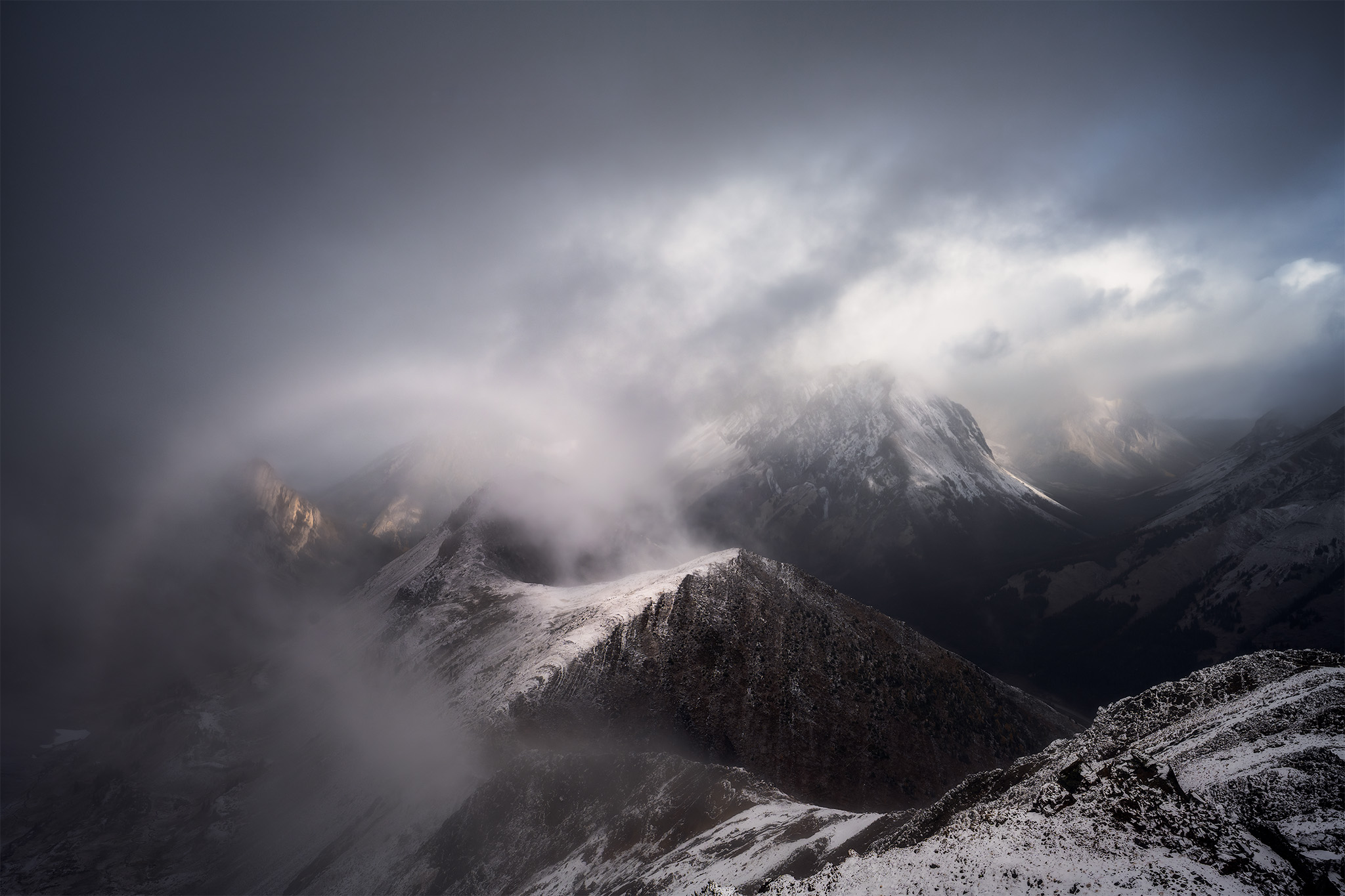
Then, suddenly, the sun broke through. For a brief moment, I could see a clear patch opening above us. I knew something was about to happen. We jumped up from behind our shelter, I pulled out my camera, and within moments we were watching one of the most incredible atmospheric phenomena I’ve ever witnessed.
A Brocken spectre appeared in the clouds around our shadows, while dramatic light broke through the storm and illuminated the distant peaks. After everything that had happened over the previous few days, I couldn’t believe what I was seeing. I had spent the morning wondering whether I could even physically finish the hike. We’d missed sunrise. We’d been buried in cloud and snow. I was sick, exhausted and questioning every decision that had led me onto that ridge. And then, for a few minutes, everything came together.
The atmosphere. The snow. The light. The mountains. The Brocken spectre. It was my Michael Jordan flu game.
I had no business being up there that morning, but somehow, the conditions gave me exactly the kind of photograph I had been hoping for all fall. And that made every miserable step worth it.
To purchase a luxury fine art print of this photo, please use the button below.