Winter photography in the Canadian Rockies is often portrayed as predictable. Snow-covered peaks, frozen lakes, and perfect alpenglow are what many photographers expect when planning a trip to Banff, the Icefields Parkway, or Kananaskis Country. In reality, conditions can vary dramatically, even in the middle of winter.
This Canadian Rockies winter photography trip report documents a week in February 2026, when deep snowpack was offset by rapidly changing temperatures, poor ice formation, and limited fresh snowfall. Locations like Castle Mountain, Bow Lake, Abraham Lake, and Tangle Ridge looked very different from their typical winter state, requiring a more adaptive approach in the field.
If you are planning a winter photography trip to the Canadian Rockies, this article offers a realistic look at what conditions can actually be like and how to adjust your approach when things do not go as expected.
If you are new to photographing the region, you can start with this complete guide to winter photography in the Canadian Rockies.
Every year, the Rockies bring a new set of challenges, and the winter of 2025 to 2026 was no exception. On paper, it sounded ideal. Some mountain weather stations reported the second deepest snowpack since records began in the mid-1980s. Great conditions for photography, right? Not quite. Photographers are a bit like farmers. We tend to notice what is not perfect.
Beyond the impressive snowfall, the defining feature of this winter was temperature variability. One week would be warm and slushy, the next cold and stormy. Because of how the moon phase aligned with a couple of shots we had planned later in the trip, Andrew and I scheduled our visit for early February, slightly later than usual. Unfortunately, that timing coincided with a week-long stretch of above-freezing temperatures and clear skies. While the snowpack was deep, surface conditions were far from ideal. The snow was old and crusty, and ice formation was poor. Lakes like Minnewanka and Abraham, which are typically frozen solid this time of year, were open along the edges. Creeks and rivers showed very little ice buildup.
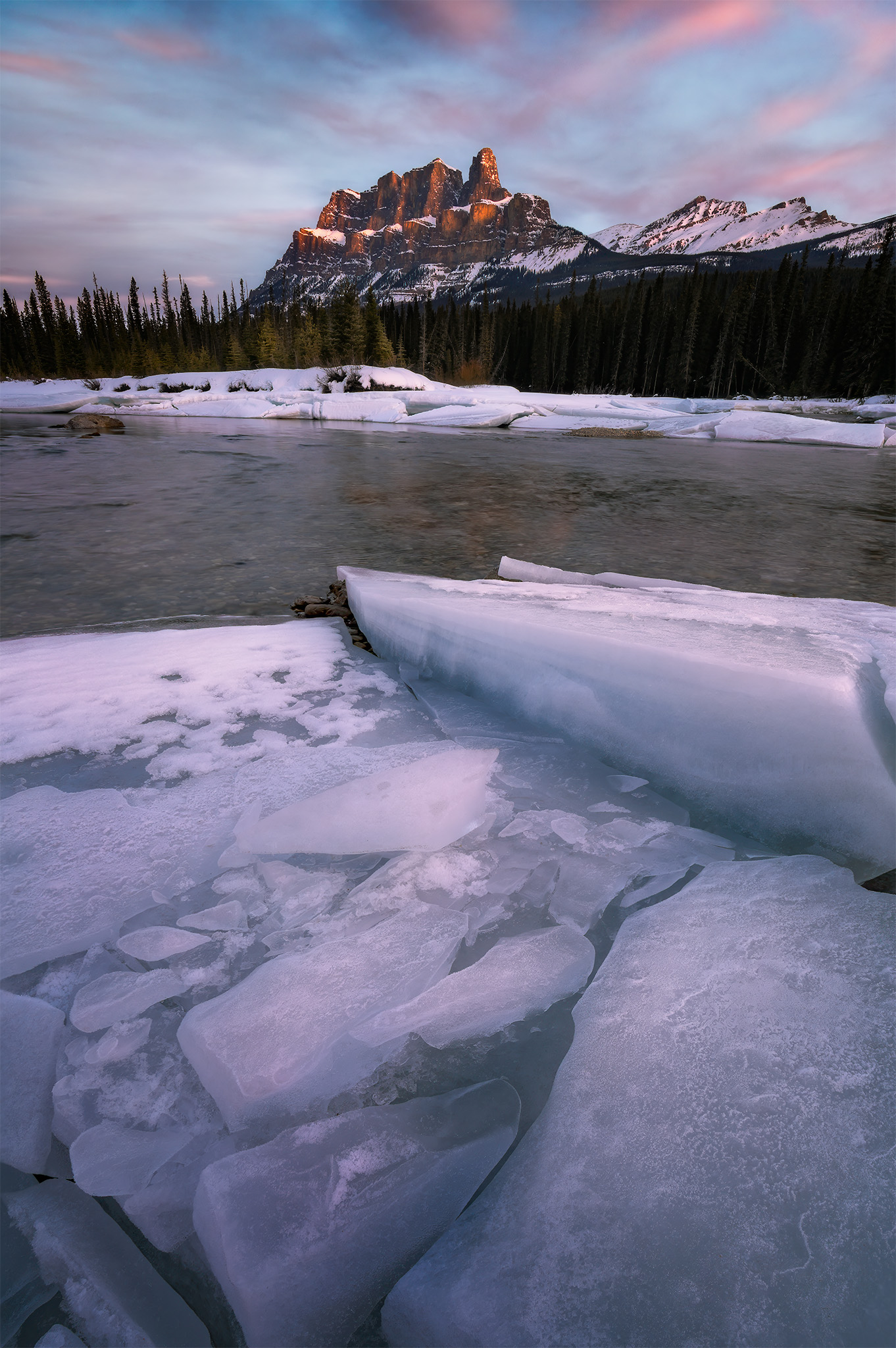
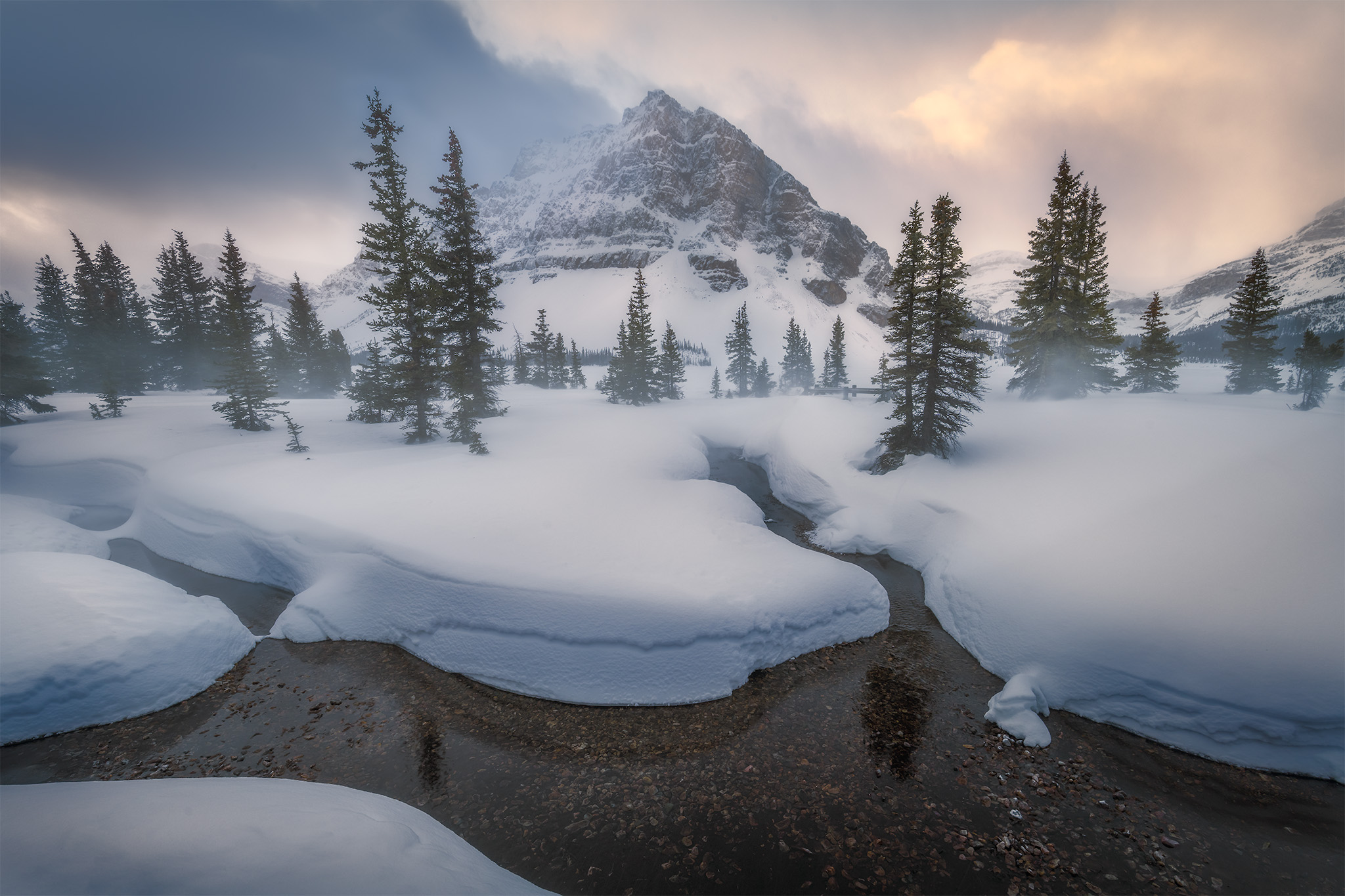
As usual, we used our first day to scout conditions. The good news was that temperatures were noticeably cooler farther north, especially along the Icefields Parkway. Our first stop was Castle Mountain. After a morning shoot, we put on waders and snowshoes and travelled a couple of kilometers downstream along the Bow River to explore a lesser-visited area. In previous years, I had seen impressive ice formations there, but I knew we would not find anything like that on this trip. Still, the extra effort paid off. We found several strong compositions and plenty of potential for future visits, so we decided to return the next morning for sunrise.
The following day, we made our way back along the trail we had already broken, which made for an easier approach. As we set up, a low bank of clouds sat on the eastern horizon, with a narrow gap beneath it. I suspected we might get a brief burst of red light at dawn, but only for a moment. Sure enough, just as I finished composing, the light warmed the clouds above the mountain and briefly touched the peak before fading behind the cloud bank. Later that morning, the light returned and softly illuminated the scene. The final image blends those two moments.
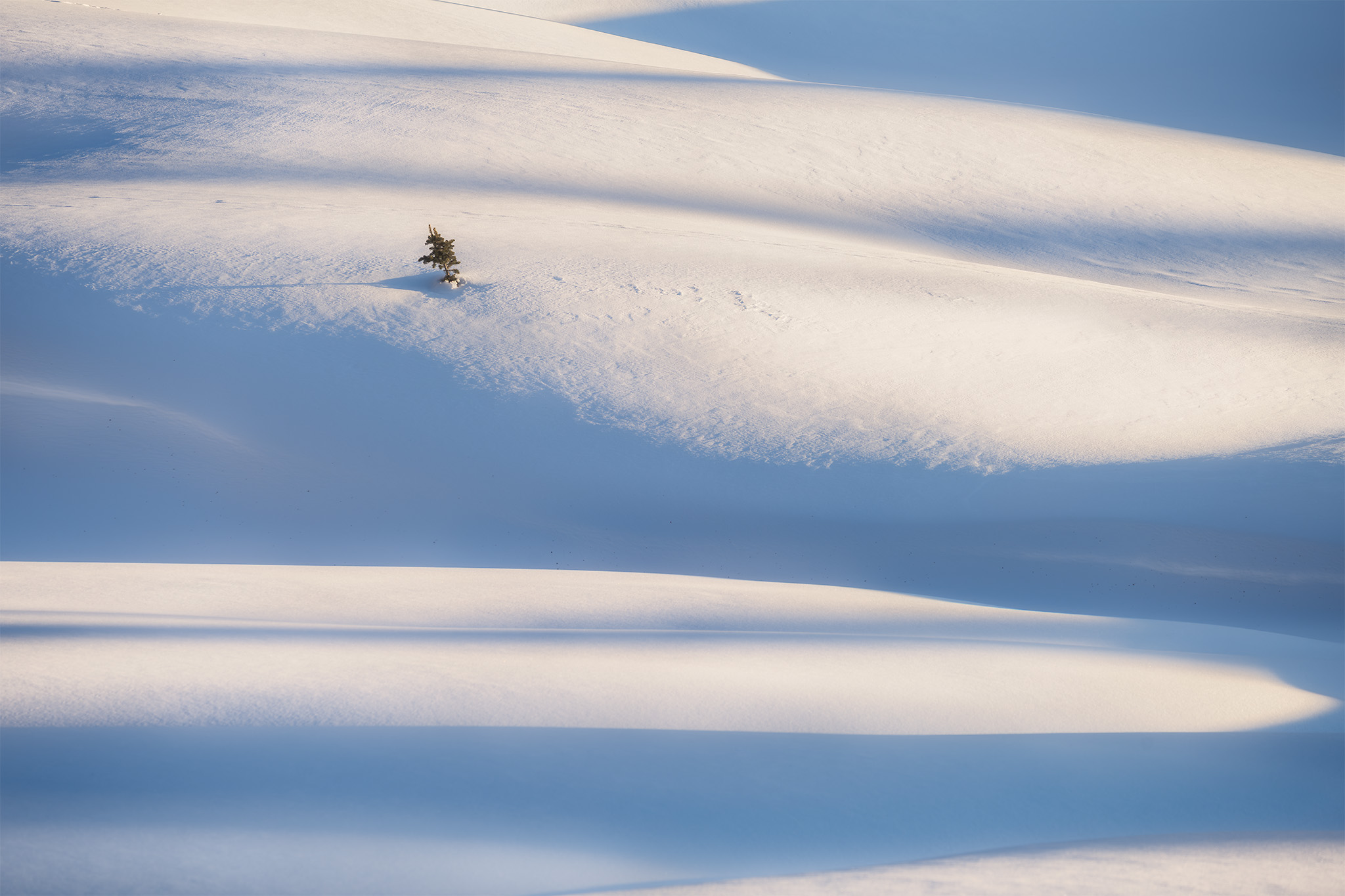
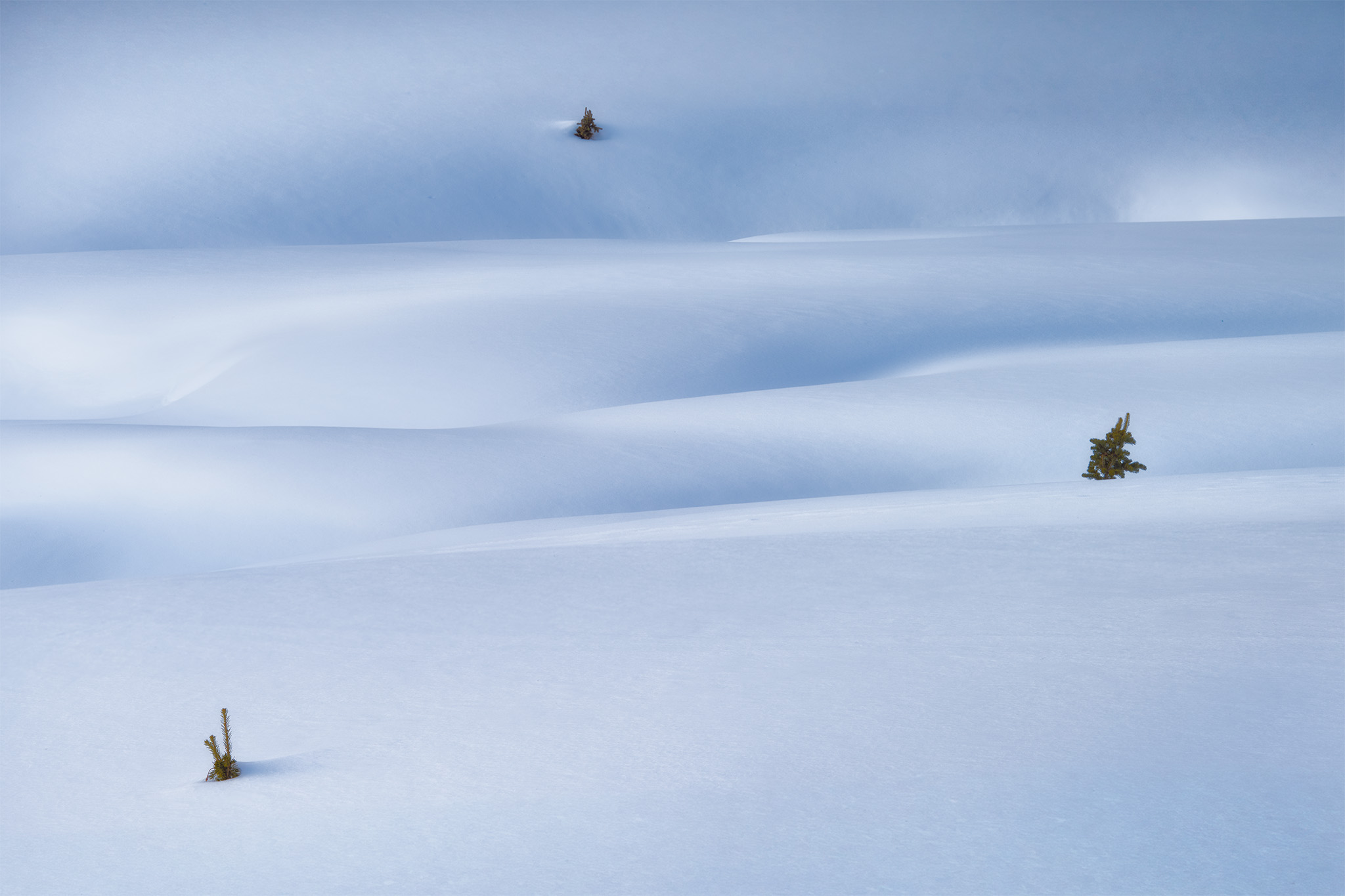
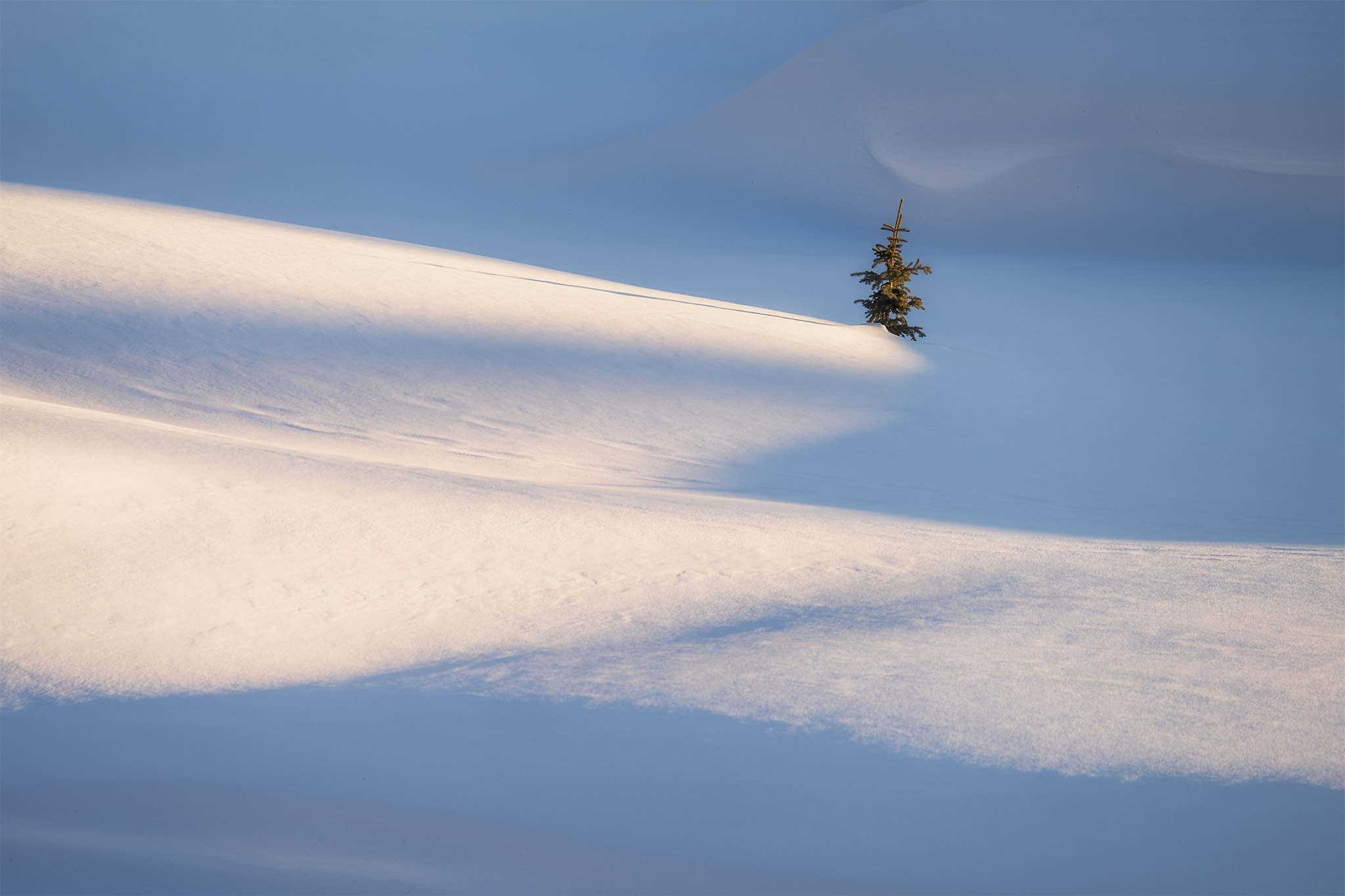
That evening, despite already covering several kilometers on snowshoes, we headed toward Chester Lake. At higher elevations, we hoped for better snow conditions. We reached the open valley below Mount Chester well before sunset. Having photographed the mountain in good light before, I was not focused on including it this time. Instead, I switched to a telephoto lens and began isolating small trees emerging from the deep snow in the warm evening light. There is something about these partially buried trees that I keep coming back to. They convey a sense of quiet solitude and stillness that resonates deeply with me. I have many images like this in my portfolio, but I do not think I will ever stop seeking them out.
Later that night, we reviewed forecasts and discussed where to go next. Both of us were exhausted, and the idea of heading up the Parkway again was not especially appealing. However, one location kept appearing consistently in the models. Tangle Ridge, nearly a three-hour drive from our place in Canmore. The next morning, we were on the road before 4:30 a.m.
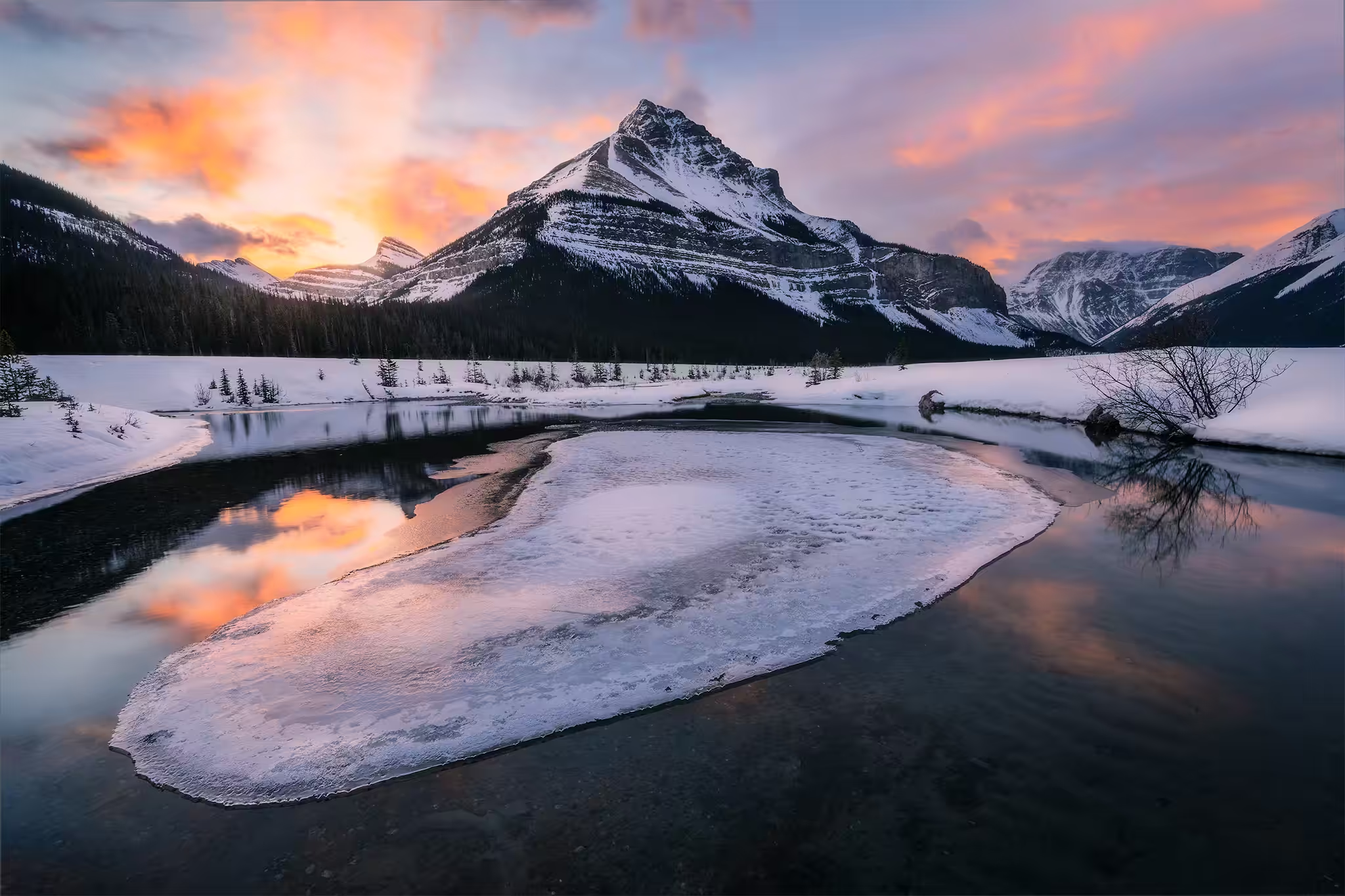
When we arrived, conditions were similar to everywhere else. The snow was aged and there was very little ice. Sunrise was approaching quickly, so I rushed to compose a scene featuring a remnant ice shelf with a winding creek. Then, unexpectedly, the light intensified. It became the most vibrant sunrise of the entire trip.
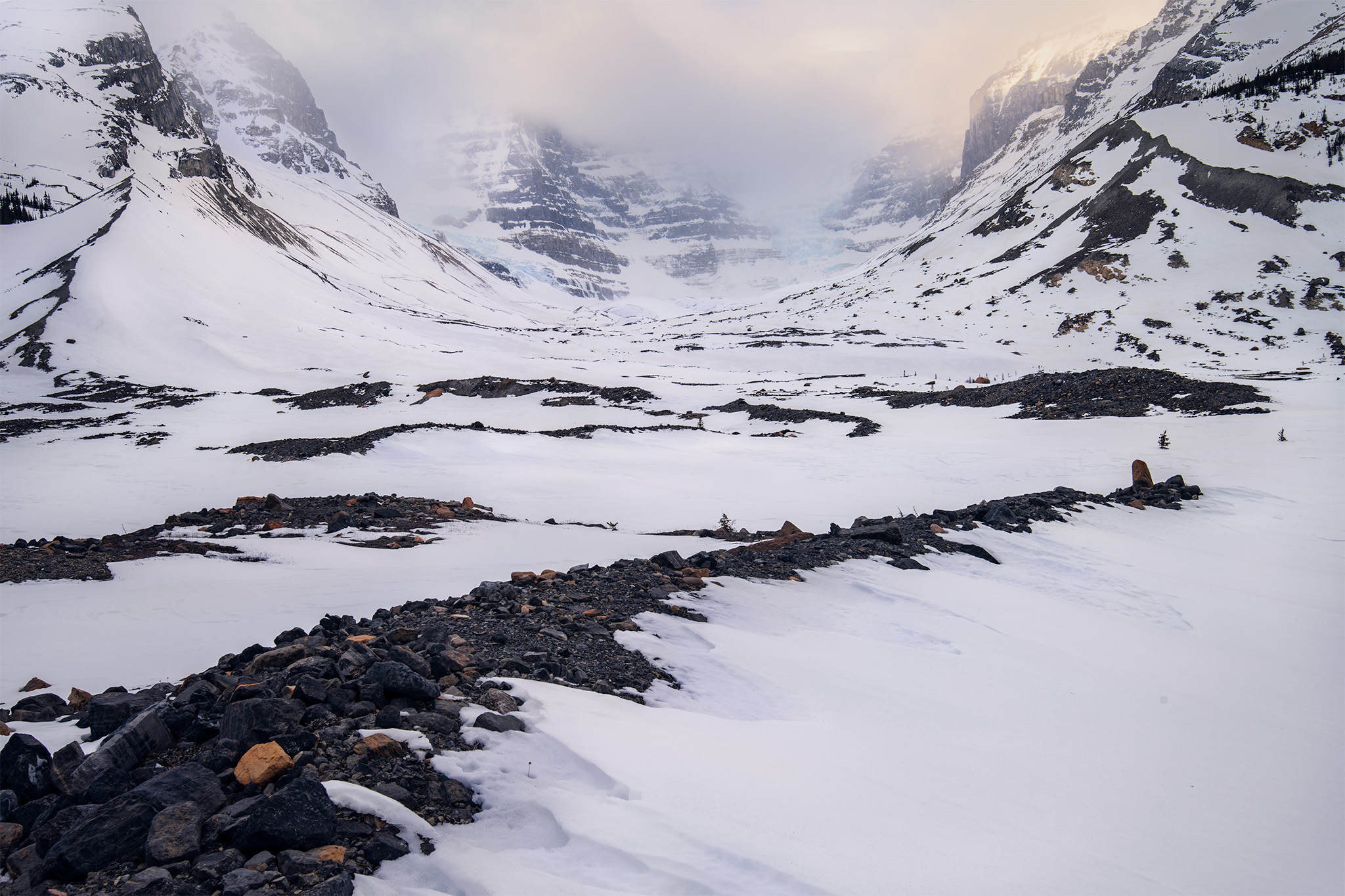
Afterward, we continued along the Parkway, following shifting light and weather. Near the Athabasca Glacier, the atmosphere stood out. Light interacted with the peaks and ice in a way that felt raw and elemental. I have always been drawn to the area’s rugged simplicity, and in that moment I wanted to create an image that reflected that same minimalism. The wind coming off the glacier was relentless, but I stayed out and worked the scene as a jagged ridge cut through the snow toward the distant peaks.
We eventually made our way south, stopping briefly at a partially frozen waterfall. Conditions were too warm to explore safely, so we continued on to Abraham Lake to check ice conditions. That stop was disappointing. It was clear we would not recover the cost of the drive; the classic Abraham Lake ice was non-existent. This became a pattern throughout the trip. Our mornings started strong as we focused on locations that we knew would work in marginal conditions, but by afternoon and sunset we often ran out of viable options.
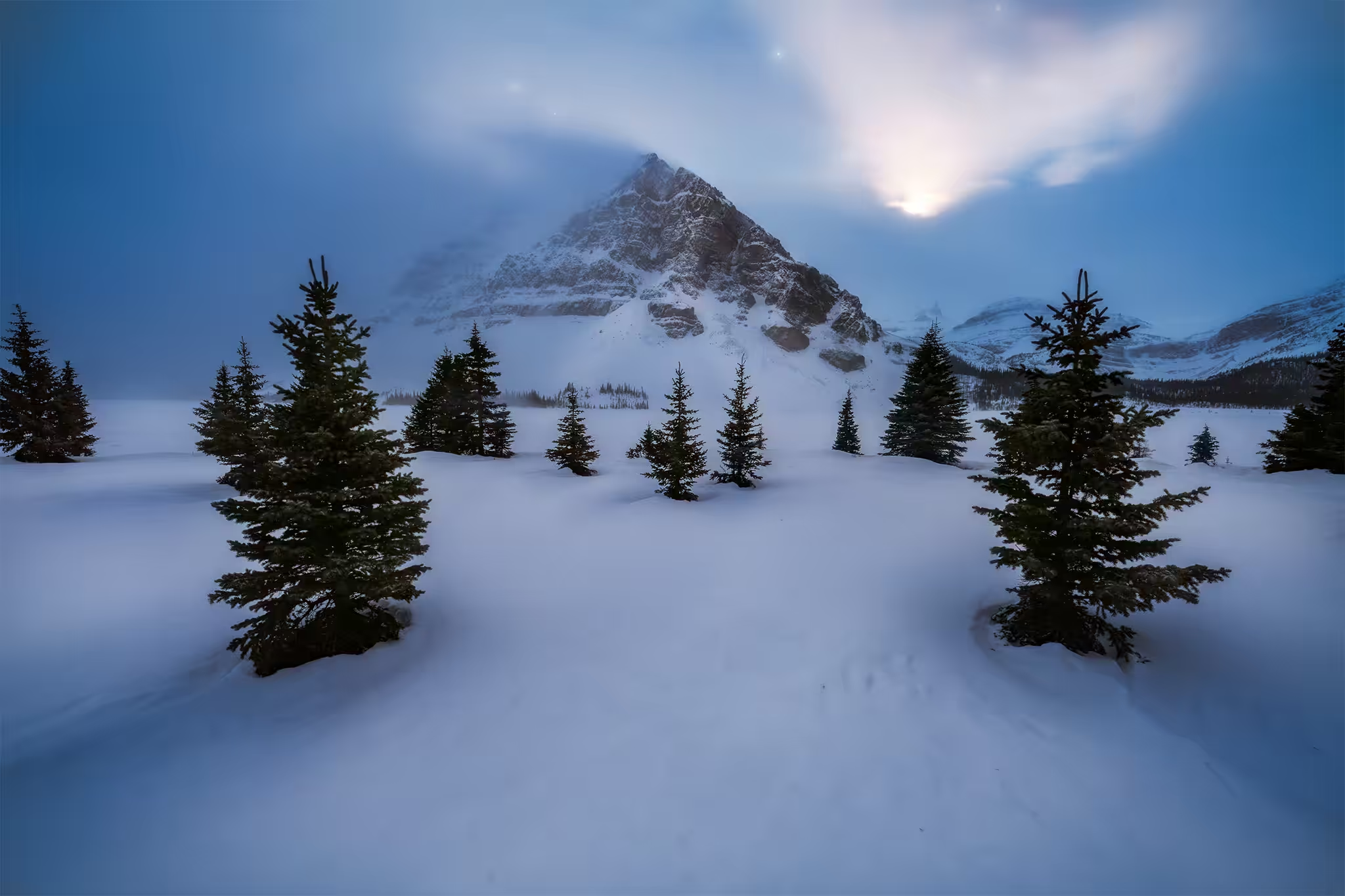
Finally, February 8 arrived, the morning we had been waiting for. Both the 8th and 9th offered excellent moon positioning and illumination. The composition I had planned for the 8th was at Bow Lake. The forecast called for overnight snow, so we drove up early with hopes of fresh snow on the trees. That did not materialize. However, the unsettled weather created dramatic conditions, including a brief break in the clouds that allowed moonlight through and strong winds that blew fresh snow across the landscape closer to sunrise. Bow Lake proved challenging as always, but I left satisfied with what we captured.
On the drive back south, we chased light and atmosphere as snow showers moved across the Parkway and Highway 1. Back in Canmore, we watched conditions develop and decided to head into Kananaskis Country to photograph incoming weather. We made our way to the valley near Mount Engadine Lodge, one of the most scenic areas in the region. Surrounded by towering peaks, it is a place I have photographed before. My main goal was to assess snow conditions for a potential moon composition the following morning.
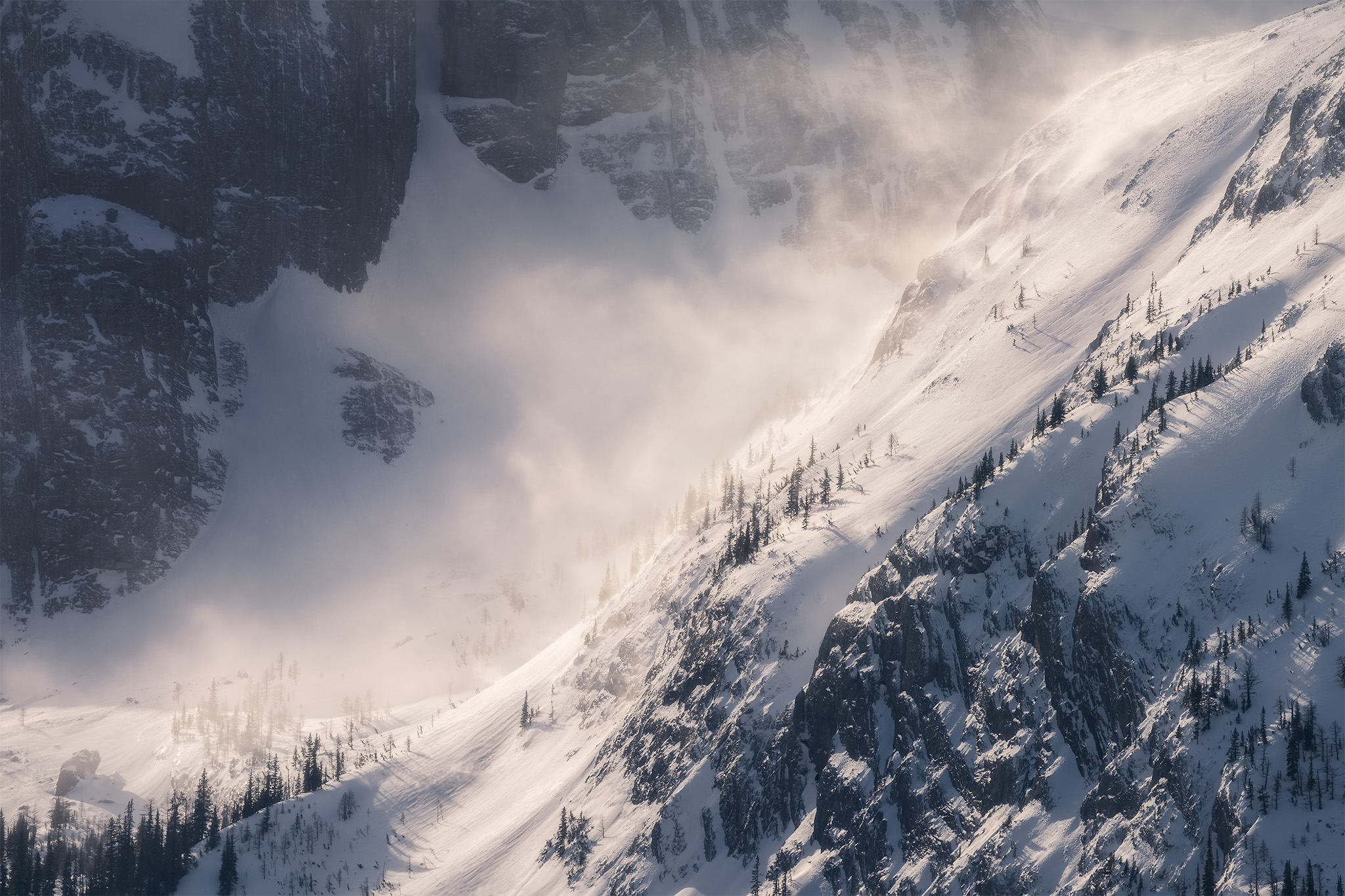
While scouting, Andrew called out, and I turned to see strong winds blowing fresh snow off distant peaks. In the soft, diffused light, it created a striking scene and resulted in one of my favorite images from the trip.
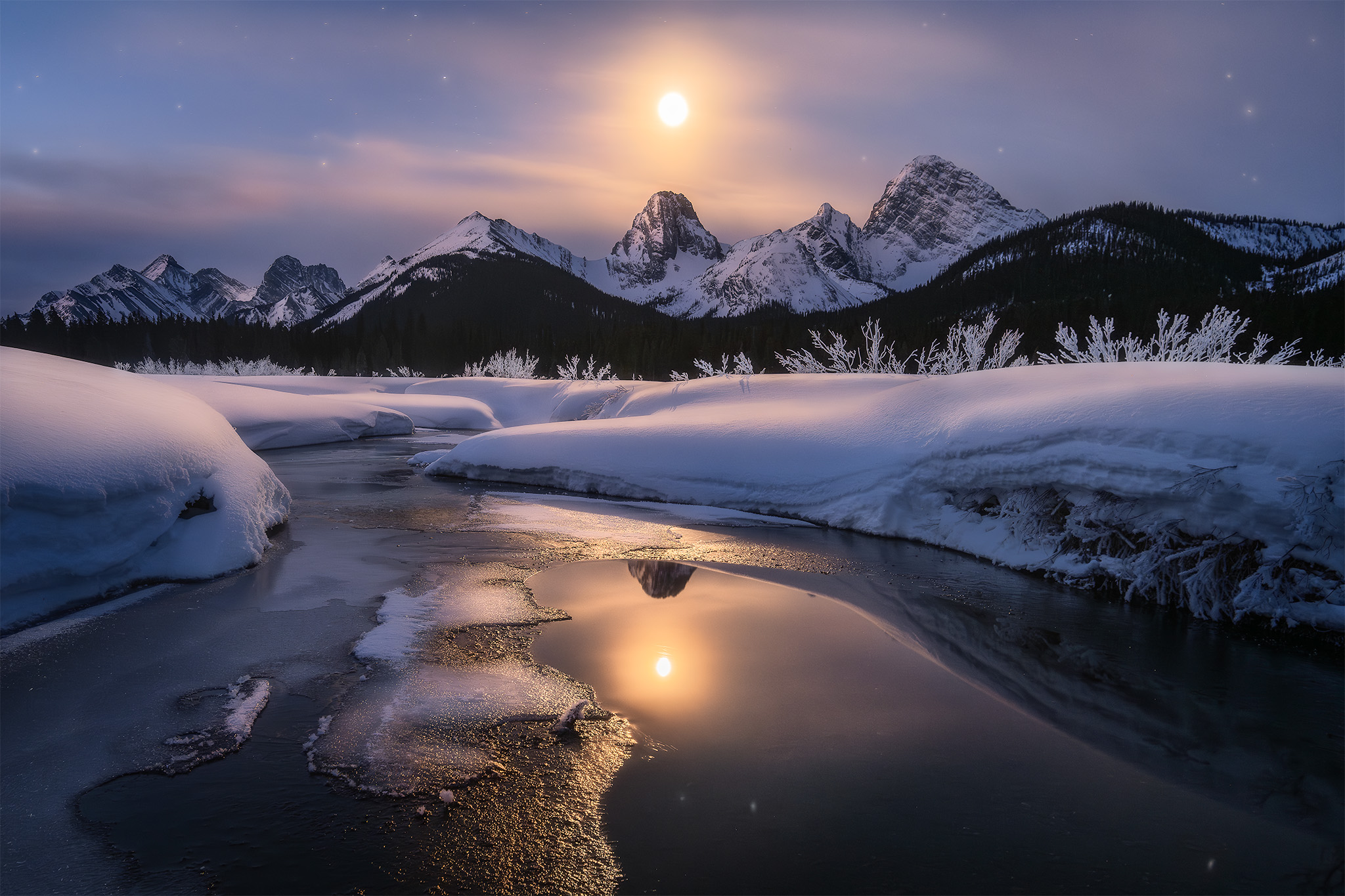
On our final morning, we returned to the same area and snowshoed down to the creek in the dark. Snow along the banks was deep, and the creek was running higher than expected for that time of year, which limited composition options. Eventually, I found a safe way down into a shallow section and quickly captured an image of the moon over Mount Birdwood and Mount Smutwood while it was in position. I was not fully satisfied with my composition and spent too much time experimenting while the moon was still aligned. As a result, the image carried more noise than I would have liked. Thankfully, newer AI denoise tools performed well and helped salvage the shot.
This trip reinforced an important reality about winter photography in the Canadian Rockies. Even when conditions appear ideal on paper, the landscape does not always cooperate. Snow quality, ice formation, and weather patterns can shift quickly, forcing photographers to adapt in real time.
The most successful moments from this trip came from staying flexible and responding to what the landscape offered. Whether it was isolating simple compositions at Chester Lake, reacting to dramatic sunrise light at Tangle Ridge, or capturing brief atmospheric moments in Kananaskis Country, each image required a willingness to move beyond the original plan.
For photographers planning a trip to Banff National Park, the Icefields Parkway, or Kananaskis Country, the key takeaway is simple. Do not rely on ideal conditions. Instead, focus on light, weather, and composition, and be prepared to adjust your approach each day.
The Canadian Rockies remain one of the most rewarding places in the world for winter landscape photography. When conditions, light, and timing align, even briefly, the results make every challenge worthwhile.


Download this FREE, 5-day landscape photography course on image composition. Learn, via email, about image composition, the importance of a subject, how to arrange successful images, and my 5 favourite approaches in the field.
I hope you enjoyed this photography guide. More information on these topics can be found in the videos at the bottom of the page. If you have any questions that you think I can answer, drop me a line! If you want to share this with your friends, then use the share links right here.